SERIES: GETTING YOUR AGENCY READY TO SELL YOUR BUSINESS | PART 4
The first three parts of this series covered how your business is valued, what buyers and lenders actually look at, and how deal structure works. This final part is about the work that makes all of those things matter.
You can understand every valuation metric perfectly and still not command a good price because the business itself isn't ready. The most common reason agency owners sell for less than they expected isn't a bad market or a tough negotiation. It's that they are the business. When they leave, the value leaves with them.
Nicole has been on the buying side of this enough times to be precise about what it costs sellers and what to do about it before you ever start a conversation with a buyer.
The Valuation Killer Most Sellers Don't See Coming
"I don't want a business that if the CEO leaves, everything falls apart."
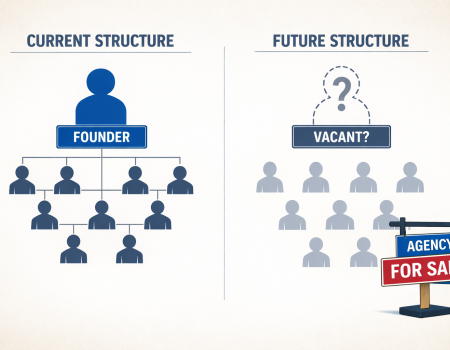
Nicole says this as a buyer evaluating whether to make an offer. A business that runs independently of its founder is something she'll pay a premium for. A business where the founder is the center of gravity — handling the key client relationships, driving new sales, making most of the critical decisions — gets discounted, because the moment that founder announces they're leaving, a significant portion of what was being purchased starts walking out the door with them.
The math is direct. As a founder, you're probably filling 2–3 critical roles simultaneously: running operations, managing key client relationships, driving new business. The moment you exit, a buyer has to hire people to fill those roles. Those new salaries reduce the profitability of the business and since the purchase price is based on profitability, your indispensability comes directly off your multiple.
Give Every Role an Owner Who Isn't You
Nicole's rule: every function in your business needs a named owner who isn't the founder. Sales, delivery, operations, client management, finance — each one needs someone who can do the work and make decisions without checking in with you first.
For most agency owners, this means elevating the people already on your team. Give them real accountability and authority over their area. The goal isn't to make yourself irrelevant, it's to make sure a buyer sees a leadership team when they look at your org chart, not a founder with a support staff.
The question to ask about every role: if I disappeared tomorrow, who owns this? If the answer is "no one" or "I'd need to hire someone," that gap will show up in what a buyer offers you.
Nicole's ideal acquisition is a business where someone already inside the organization could step directly into a CEO or managing director role. She's specific about this: that's not a nice-to-have. It's a premium she'll pay for.
If It Only Exists in Your Head, It Doesn't Count
Whenever a process depends solely on your personal knowledge or judgment to function, a buyer treats that dependency as risk. How you price projects, how you handle difficult client conversations, which vendors you trust, what your delivery standards actually look like — every one of those is a dependency a new owner has to figure out from scratch.
The more you can put everything into writing before a sale the less a buyer has to rely on trust alone. Documentation doesn't need to be elaborate. It needs to exist somewhere other than your head.
Your Pipeline Has to Work Without Your Rolodex
One of the clearest signals Nicole looks for when she's evaluating an acquisition is whether new business comes in through a system or through the founder's personal reputation and relationships.
If your leads come from people who know you personally, and your relationships are what close the deals, you're not really selling a business. You're selling yourself. And you can't transfer yourself to a new owner.
What a buyer needs to see: a process for generating leads, a process for converting them, and a track record showing it works without any single person being essential to it. That's what creates real confidence that revenue will continue after the transition and it's a meaningful driver of your multiple.
Build Your Deal Room Before Anyone Asks for It
This is Nicole's most immediately actionable piece of advice and the one most first-time sellers overlook entirely. Don't wait for a buyer to ask for documents. Build your deal room now, update it every month, and share it the moment a serious conversation starts.
"The moment the right op comes, you just give them your deal room… now you're prepared."
A deal room is a folder, Google Drive works perfectly, containing everything a serious buyer needs to evaluate your business. Having these documents signals that you know exactly what you have and you're not going to be pushed around on price.
What Goes in Your Deal Room
- Monthly P&Ls, kept current
- A 3–5 year financial history (full calendar years)
- A trailing 12-month snapshot — the last 12 months shown month by month
- A 12-month forward projection — your best estimate of the coming year
- Full employee roster: titles, fully loaded costs (salary + benefits + taxes), location, and which clients they support
- Complete client list showing monthly revenue from each client over the last 3 years
- All contracts and terms
Preparation Doesn't Just Help, It Changes Who Shows Up
Coming prepared with a complete deal room and a clear understanding of your SDE multiple changes who you attract and what they offer. Nicole is direct: low-ball structures — tiny upfronts, massive earn-outs, terms heavily weighted against the seller — tend to come from buyers who are counting on sellers not knowing their numbers. A prepared seller makes those offers obviously out of place.
When you know what your business is worth and can prove it on paper, the negotiation starts from a completely different position. You're not learning the language of the deal while someone is across the table from you. You already know it.
Your Pre-Sale Checklist
Work through this before you start any conversations with buyers. It shows you what's ready and what still needs attention.
- Every key role has a named owner who isn't me
- A leadership candidate exists inside my organization who could step into a CEO or MD role
- My sales pipeline generates leads and closes deals without depending on my personal relationships
- My P&L (profit and loss statement) is structured in the 50-30-20 format with recurring and project revenue clearly separated
- My tax returns show 3 years of clean, profitable performance
- I know my SDE and can clearly document my add-backs
- I know my approximate multiple range and understand what's holding it back
- My deal room is built and I update it every month
- I know what transition looks like for me — how long I'm willing to stay involved and in what capacity
Closing Thought
A sellable business is a well-run business. Every improvement you make to leadership depth, pipeline independence, and financial documentation makes your business more valuable — whether or not you ever sell. Start now, even if a sale is years away. The founders who walked away with the best outcomes didn't get lucky. They prepared.
This four-part series is based on a conversation with Nicole Pereira, serial founder and three-time agency seller.